
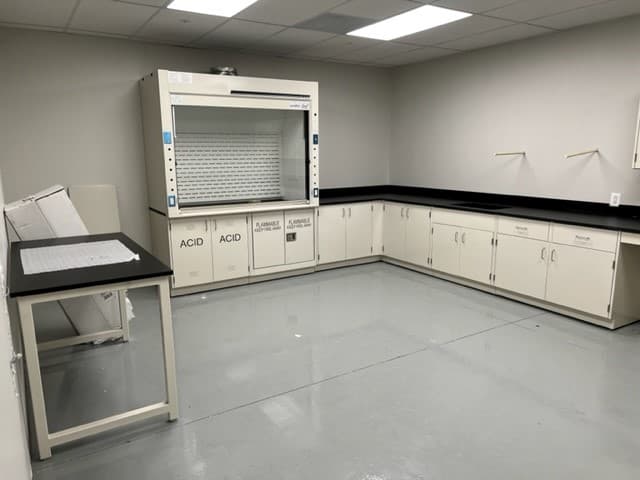
Metal casework outlives most of what sits on top of it. Benches installed in the 1990s are still in service in labs across the region, which is exactly why the material decision deserves more than a line item on a bid.
There are two realistic choices in metal laboratory casework: powder-coated steel and stainless steel. They are not interchangeable, and the right answer depends on the room, not the preference.
Powder-coated steel
Powder-coated steel is the default for general laboratory work, and it covers most projects.
- High structural strength and load capacity
- Durable powder-coated finish for corrosion and chemical resistance
- Cost-effective compared with stainless steel
- Suited to general lab environments and mixed-use spaces
- Available in a range of colors — see the metal color wheel (PDF)
If your chemistry is routine, your room is dry, and nobody is hosing anything down, this is where the project lands. The money saved on casework usually belongs in the hoods or the work surfaces instead.
Stainless steel
Stainless steel is specified when cleanliness, corrosion, or moisture rules the room.
- Superior resistance to chemicals, moisture, and corrosion
- Non-porous, easy-to-clean surfaces for critical environments
- Suited to sterile, cleanroom, and high-humidity applications
- Long-term performance in harsh or washdown conditions
- Available in 304 or 316 stainless
Type 316 is the choice where chloride or more aggressive corrosion is in play. If a room gets washed down, or if contamination control drives the design, stainless stops being a premium and starts being the requirement.
How to decide
Four questions settle most of it:
- What hits the cabinet exteriors? Splashes and spills wear finishes from the outside in. The exterior environment matters as much as what is stored inside.
- How is the room cleaned? Wiped down, or washed down? Washdown means stainless.
- Is contamination control part of the spec? Sterile and cleanroom work needs non-porous, cleanable surfaces throughout.
- What is stored inside? Corrosives and flammables belong in cabinets built for them rather than in standard base cabinets — see free standing and safety cabinets for acid, flammable, and vacuum pump configurations.
It is normal for one lab to use both. A stainless run at the washdown end and powder-coated steel through the rest of the room is a common, sensible outcome.
What the construction gives you
Our metal casework systems are built with high-gauge steel and laboratory-grade finishes, which is what delivers:
- Resistance to chemicals, moisture, and daily wear
- High load-bearing capacity for equipment and instrumentation
- Fire-resistant properties
- Cleanable, non-porous surfaces for hygiene and contamination control
Where metal is not the answer
Some rooms call for something else entirely. Wood casework still suits teaching and general labs, polypropylene handles acid and trace-metal work where metal corrodes, and health care casework is built for clinical spaces. Material selection should follow the application, exposure conditions, and performance requirements — not the catalog page you happened to open first.
The steel casework catalog (PDF) has the full configuration list. If you are weighing steel against stainless for a specific room, tell us what happens in it and we will give you a straight recommendation. LF Systems has been specifying and installing laboratory casework in DE, MD, PA, and NJ since 1983.