
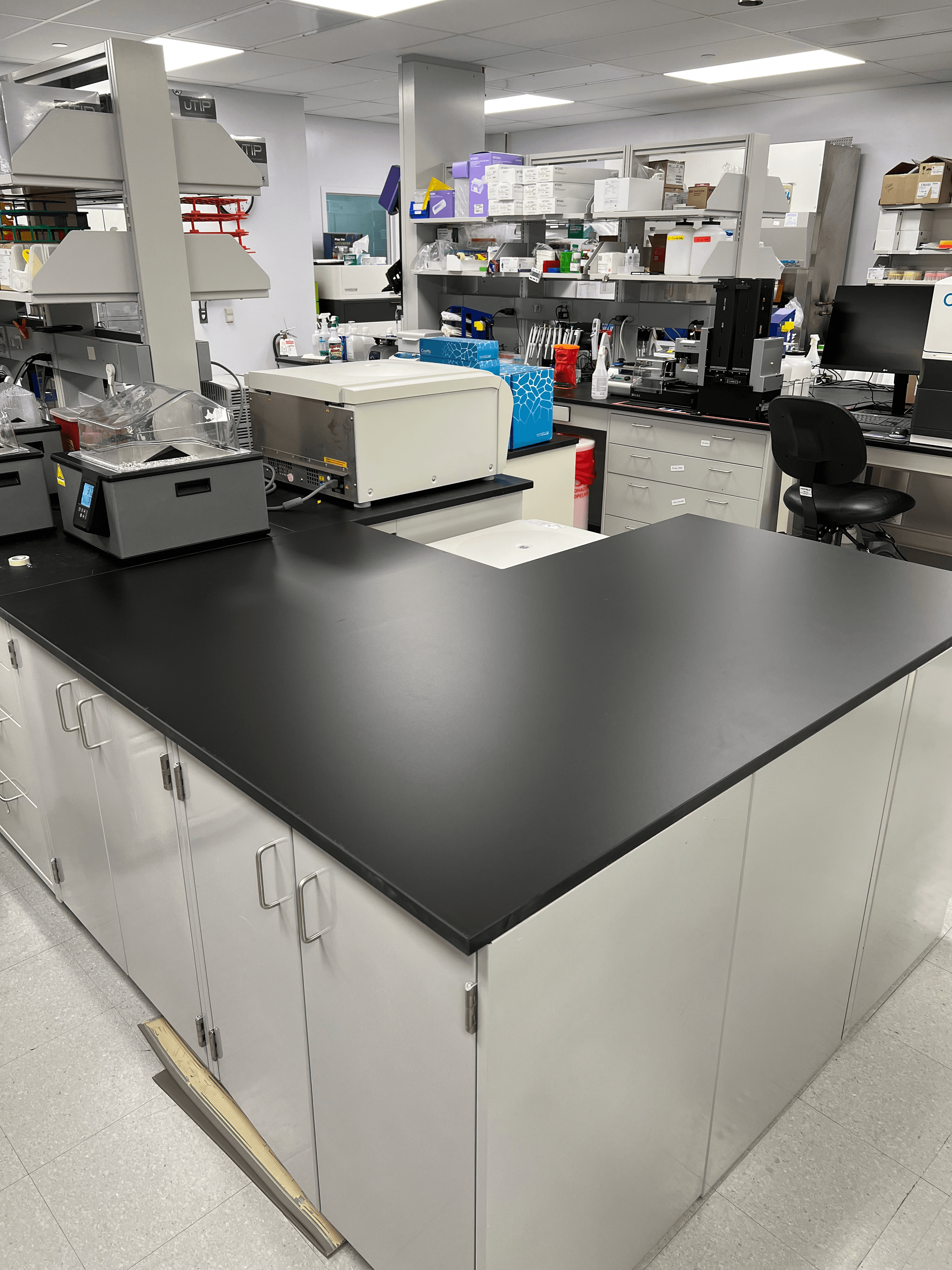
Searching for lab furniture companies turns up catalogs. What a lab actually buys is a sequence: a layout that works, casework that survives the chemistry, hoods that pass testing, an installation that lands on schedule, and somebody who answers the phone in year seven.
Plenty of suppliers do the first part. Fewer do all of it. These are the questions that tell you which kind you are talking to.
1. Can they plan the room, or only quote from your drawing?
A supplier who starts with a product list will sell you products. A partner starts with the room, the workflow, the utilities, and the code requirements. Ask whether laboratory planning and CAD engineering are in-house, and ask to see drawings they have produced.
2. Do they install, or subcontract it?
Installation is where lab projects go wrong — utility rough-ins that do not match the casework, hoods set before the exhaust is ready, countertops cut on site because a dimension moved. A supplier whose own crew handles installation carries that risk instead of passing it to you.
3. Will they service equipment after the project closes?
This is the question that separates the field most cleanly. Casework and hoods last 15 to 20 or more years. Ask who repairs a failed sash in year eight, and whether they service hoods they did not sell. We service hoods from virtually all manufacturers through our repair and maintenance programs.
4. How deep is their field experience, specifically?
"Decades of experience" means little without the detail behind it. Ask how many hoods their team has installed and maintained, in what kinds of facilities, and what they do when field conditions do not match the drawing — because they will not. Our team brings over 100 years of combined field experience across healthcare, pharmaceutical, industrial, municipal, and higher education labs.
5. Are they an authorized dealer for what they sell?
Authorized dealers get current catalogs, correct option lists, real lead times, and warranty support. LF Systems is an authorized ICI Scientific dealer, and we hold affiliations with ASHRAE and ISPE.
6. Can they match materials to your chemistry?
A supplier should ask what you work with before recommending a finish. The honest answer varies by room: powder-coated steel or stainless in metal casework, polypropylene for acid and trace-metal work, wood for teaching and general labs, and epoxy, phenolic, or stainless work surfaces depending on exposure. Anyone with one answer for every lab is selling inventory.
7. Do they handle hoods and casework together?
Fume hoods tie into the building — exhaust, HVAC load, controls. Casework ties into utilities and the floor plan. When two vendors own those scopes, the seams between them become your problem. One team covering fume hoods and airflow systems alongside casework removes a coordination layer.
8. Are they close enough to show up?
Regional matters more than people expect. Site visits during design, punch-list fixes, and a service call next week all depend on someone being a drive away. LF Systems works across Delaware, Maryland, Pennsylvania, and New Jersey, from New Castle, DE.
9. Will they tell you not to buy something?
The most useful supplier conversation is often a smaller one: an enclosure instead of a hood, a rebuild instead of a replacement, a canopy hood instead of a fume hood for an autoclave. A vendor who only ever recommends more equipment is optimizing something other than your lab.
Start with your own list
Before contacting anyone, write down the chemistry, the equipment that has to fit, the utilities already in the room, the schedule, and who has to approve the result. Most of a bad lab furniture purchase traces back to one of those being assumed rather than stated.
LF Systems has been planning, supplying, installing, and servicing laboratory furniture and fume hoods since 1983. If you are putting a project together, send us what you have — drawings, a photo, or a rough description — and we will tell you what it needs. Our resources page has the full catalogs if you would rather start by reading.