
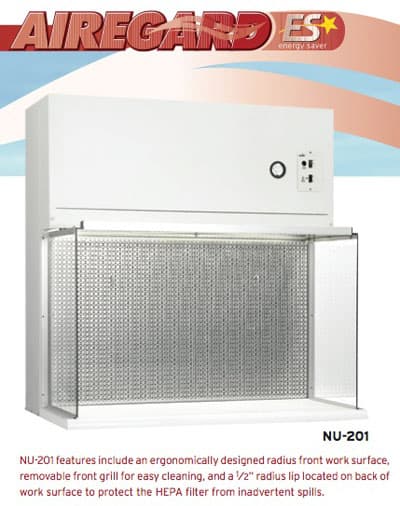
Biosafety cabinets rarely cause trouble on their own. The problems show up around them: a cabinet on a stand that is the wrong height for the bench next to it, a unit installed where the certifier cannot reach the filter, or utilities roughed in on the wrong side.
Before accessories, it is worth being precise about which enclosure you actually have, because the three get mixed up constantly.
Three enclosures that look similar
- A fume hood protects the user from chemical vapors by pulling room air across the work and exhausting it.
- A biosafety cabinet protects the user, the product, and the environment from biological material, using HEPA filtration and a controlled airflow pattern. Class and type determine whether it recirculates or exhausts, and whether it can handle any chemistry at all.
- A laminar flow hood protects the work, not the user. HEPA or ULPA filtered, unidirectional airflow sweeps contaminants away from the work surface, but airflow is directed toward the operator — so these are for non-hazardous applications only, never for toxic chemicals or hazardous materials.
If someone is choosing between them on price, that is the conversation to stop and have first. The accessories below only make sense once the enclosure class is right.
Accessories usually specified with a cabinet
Most manufacturers offer some version of these, and they are decided at order time:
- Base stand — fixed-height or adjustable, with or without casters and levelers. Match the stand to the bench height beside it so a user is not reaching up or down between the cabinet and the adjacent work surface.
- Work tray and interior fittings — removable trays, armrests, and drain pans that come out for cleaning.
- UV decontamination lighting — an option on many clean-air enclosures, including our laminar flow hoods, for pre-use decontamination.
- Service fixtures — vacuum, gas, and receptacles inside the cabinet, placed where the work happens.
- Filters and exhaust connection — HEPA or ULPA filtration plus, for exhausting cabinets, a thimble or hard duct connection that has to be coordinated with the building exhaust.
- Alarms and monitors — airflow and sash alarms, where the application or the authority having jurisdiction calls for them.
The parts we handle
LF Systems supplies clean-air enclosures in the form of laminar flow hoods and ventilated enclosures, and we build the lab around whatever enclosure a project specifies:
- Benches and casework at the right height and depth beside the cabinet, in metal or stainless steel where cleanability matters
- Cleanable, non-porous work surfaces for sterile and low-particulate environments
- Safety fixtures — eyewashes, drench hoses, and showers — placed so they stay accessible after the equipment goes in
- Laboratory planning, CAD engineering, and installation so the cabinet, utilities, casework, and clearances resolve on paper before anything is ordered
Leave room for certification
A biosafety cabinet is field-certified after installation and then periodically afterward. That takes access — around the unit, to the filter housing, and to the exhaust connection. Clearance gets designed out of a layout easily, especially when a cabinet is squeezed between a wall and a run of casework late in a project.
If you are laying out a lab around a biosafety cabinet, or trying to work out whether your application needs a BSC, a laminar flow hood, or a ventilated enclosure, send us the details. We have been planning labs in Delaware, Maryland, Pennsylvania, and New Jersey since 1983.