
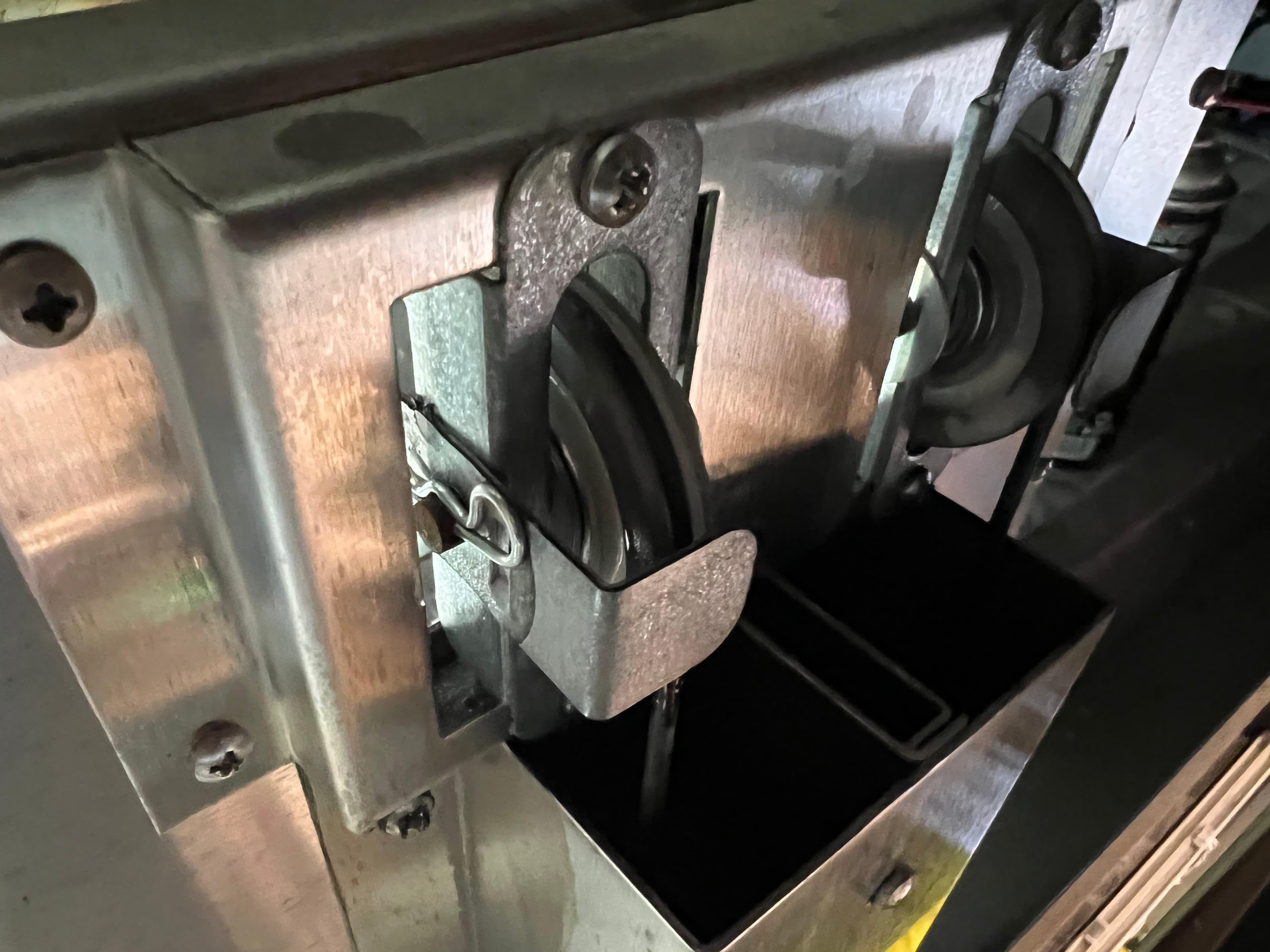
If your lab has variable air volume hoods, there is a small component on each one that quietly controls how much conditioned air leaves the building: the sash position sensor.
Why the sensor exists
A conventional fume hood is designed around a face velocity, typically 100 feet per minute at the sash opening. There are two ways to deliver it:
- CAV (constant air volume) exhausts the same volume whether the sash is open or closed. It is the standard operation across the F-Series hoods.
- VAV (variable air volume) reduces exhaust as the sash closes, and is available as an option. It needs to be coordinated with the building's HVAC controls.
VAV only works if the control system knows where the sash is. That is the sensor's job: report sash position so the controller can modulate the exhaust damper and hold face velocity as the opening changes. Close the sash, the opening shrinks, the controller throttles back, and the building stops paying to exhaust air it does not need to.
How position is sensed
Implementations vary by controls manufacturer, but they fall into a few families:
- Cable or string potentiometer — a retracting cable attached to the sash turns a potentiometer as the sash moves.
- Magnetic or proximity switches — discrete positions rather than continuous travel, often used for a simple open/closed state or an alarm threshold.
- Sidewall sensor arrays — infrared or proximity sensors along the sash track, common on horizontal and combination sashes where multiple panels move independently.
Sensors are part of the hood's controls package, so they are commissioned and calibrated with the airflow monitor and the exhaust valve, not in isolation.
Symptoms worth investigating
Several complaints get blamed on the sensor, and only some of them are the sensor:
- Alarm with the sash closed, or no alarm with it wide open. Often a calibration or linkage issue — the sensor is reporting a position the sash is not actually in.
- Exhaust that does not respond to sash movement. Could be the sensor, the controller, or a stuck damper. It needs to be traced, not guessed.
- A sash that does not travel smoothly, or will not stay where it is set. This is usually mechanical, not electronic. Worn cables, chains, pulleys, sprockets, or out-of-balance counterweights make the sash drag, stick, or creep — and a sensor cannot report a position correctly if the sash is not moving correctly.
- A sash that is heavy to open. A mechanical problem that also changes how people use the hood. Users who find a sash hard to move tend to leave it open, which defeats the point of a VAV system entirely.
Start with the mechanical side
The sash system is one of the most common failure points in a fume hood, and it is where we see the most avoidable problems. Cables, chains, pulleys, and counterweights wear with daily use.
Our Sash Rebuild Program (SRP) repairs or fully rebuilds cable/pulley and chain/sprocket systems, including:
- Replacement of cables, chains, pulleys, and worn components
- Counterweight adjustment and system balancing
- Sash alignment and operational testing
- Documentation of performance and completed work
Our Preventive Maintenance Program (PMP) adds sash force testing, inspection of mechanical components and wear points, cleaning and lubrication of moving systems, and identification of failures before they occur. Most repairs are completed with minimal or no HVAC disruption, inside existing lab configurations.
Sensor and controller work itself belongs with your controls contractor or the controls manufacturer, since the sensor is one element of a building system. What we do is make sure the mechanical sash the sensor is watching moves the way it is supposed to — and, through our Hood Enhancement Program, convert sash systems, replace liners, baffles, and glass, and integrate updated fixtures on hoods that are otherwise sound.
We service hoods from virtually all manufacturers, with over 100 years of combined field experience across healthcare, pharmaceutical, industrial, municipal, and higher education labs. If a sash is dragging, alarming, or fighting your airflow controls, tell us what it is doing.