
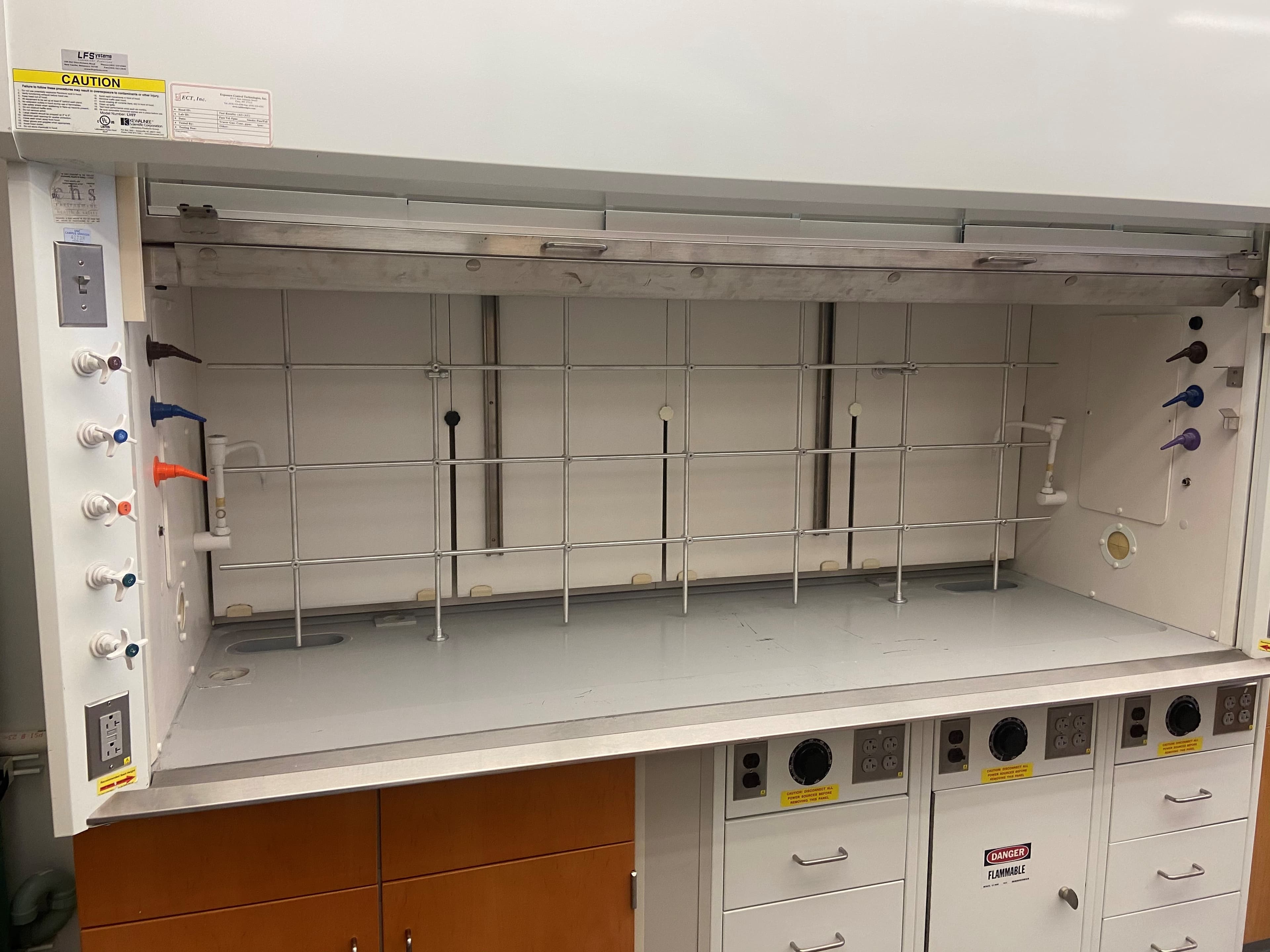
A fume hood is the one piece of safety equipment in the lab that people trust without being able to see whether it is working. Containment is invisible. The only way to know a hood still performs is to test it, and the only way to keep it performing is to maintain the parts that wear.
Those are two different activities, and labs often buy one while assuming they got both.
Testing versus maintenance
Performance testing answers one question: is this hood containing right now? It is done with instruments — face velocity readings across the sash opening, airflow visualization with smoke or fog, and, on a full containment test, tracer gas. ASHRAE 110 is the test method commonly referenced for the tracer gas procedure, and ANSI/AIHA Z9.5 is the lab ventilation standard usually cited for face velocity and operating criteria. Your institution's EHS group, insurer, or accrediting body sets the cadence; annual is typical, with retesting after any change to the hood, the ductwork, or the room's airflow.
Preventive maintenance answers a different question: how long until something fails? That is mechanical inspection and service of the parts that wear with use.
A hood can pass a velocity reading in the morning and have a sash cable fail that afternoon. You need both.
What a mechanical inspection covers
Our Preventive Maintenance Program (PMP) is scheduled around the lab's usage and environment rather than waiting for a failure. A typical visit includes:
- Sash force testing and performance evaluation
- Inspection of mechanical components and wear points
- Cleaning and lubrication of moving systems
- Adjustment of counterweights and alignment
- Identification of potential failures before they occur
Programs can be structured annually or customized to the facility. The point is to catch the cable fraying before it snaps, and the counterweight drifting out of balance before a user is fighting the sash every day.
Signs a hood needs attention before its next scheduled visit
Call sooner if you see any of these:
- A sash that is heavy, drags, sticks, or creeps down on its own
- Visible damage to the liner, baffles, or glass
- Alarms that trigger with the sash closed, or stay silent with it open
- Chemical odor in the room when the hood is in use
- Staining, residue, or corrosion inside the hood or at the baffles
- Anything stored in the hood that blocks the baffle slots
The last one is the most common and the easiest to fix. A hood packed with bottles and equipment is a hood with disrupted airflow, whatever the last test report said.
What happens when something fails the inspection
Findings fall into three buckets, and each has a program:
- Sash system wear goes to our Sash Rebuild Program (SRP) — cables, chains, pulleys, and sprockets repaired or fully rebuilt, counterweights balanced, sash aligned and operationally tested, with documentation of the completed work.
- Aging or underperforming hoods go to our Hood Enhancement Program (HEP) — sash system conversions, replacement of liners, baffles, and glass, structural and casework modifications, and updated service fixtures. These are targeted upgrades rather than full replacement.
- Hoods at the end of their life become a replacement conversation. Fume hoods are typically expected to perform for 15 to 20 or more years, and without maintenance, degradation starts well before that. If replacement is the answer, our guide to choosing a fume hood walks through matching a hood to the work.
Most of our repairs are completed with minimal or no HVAC disruption, inside existing lab configurations, with scheduling coordinated around active operations. Labs cannot afford to shut down a wing for a sash rebuild.
Keeping records
Whoever inspects your hoods should leave documentation behind: what was tested, what was measured, what was serviced, and what was flagged. That record is what an auditor asks for, and it is also how you spot the hood that needs service twice as often as the rest of the room.
LF Systems has specified, installed, maintained, and repaired fume hoods since 1983, servicing hoods from virtually all manufacturers across Delaware, Maryland, Pennsylvania, and New Jersey. To get hoods looked at, contact us and select Fume Hood Testing or Preventive Maintenance Plan as the service type.