
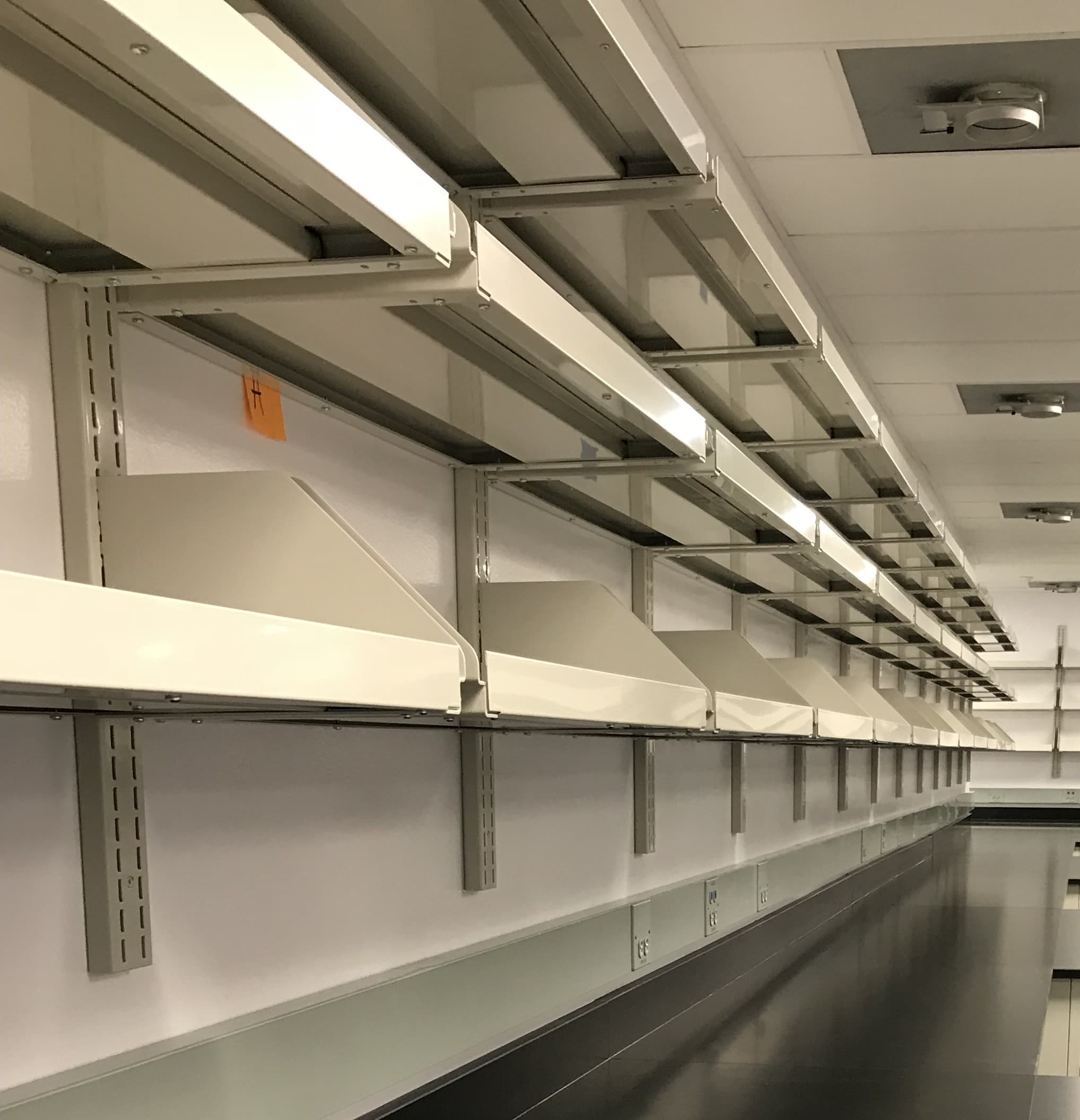
Bench clutter is almost never a storage shortage. It is a storage-in-the-wrong-place problem. The wall above a bench is usually the most underused surface in the lab, and it is the cheapest space to reclaim.
What adjustable wall shelving does
Adjustable wall shelving mounts directly to the wall and creates organized storage above the work surface, keeping materials visible, accessible, and off the bench. Shelf heights adjust, so storage adapts as the work changes without replacing the system.
The practical advantages:
- Quick, tool-free shelf adjustment as storage needs change
- Flexible configurations for different container sizes
- Reconfiguration without removing or replacing the system
- Efficient use of vertical space, which reduces bench clutter
That last point is the one lab managers feel. Reagents at eye level instead of spread across the bench means more usable work surface without touching the floor plan.
Choosing a material
Shelving material follows the same logic as casework — match it to exposure:
- Painted steel for general laboratory environments
- Stainless steel where corrosion resistance and cleanability matter
- Laminate or phenolic shelving where chemical resistance is the priority
Support systems are built for long-term loading, which matters when shelves fill with glassware and bottles rather than paperwork.
Where it beats the alternatives — and where it does not
Wall shelving is one of several storage options, and they solve different problems:
- Stacked reagent shelving sits on the bench itself, giving tiered reagent storage at the point of use rather than on the wall. Good where there is no usable wall, or where the bench is an island.
- Countertop flex shelving works with table systems where the bench layout changes.
- Post mounted wire shelving handles bulk and heavy storage, with tool-free adjustment in 1" increments, an open-wire design for airflow and visibility, and mobile track integration for high-density storage rooms. This is the answer for a storage room, not for above a bench.
Three things to check before ordering
- What is behind the wall. Mounting into stud, block, or drywall changes the hardware and the load you can hang. Settle it before layout is final.
- What is below the shelf. Shelving above a sink or a hood needs to clear the fixtures, the sash travel, and the airflow at the hood face. Nothing stored on a shelf should end up in a hood's air path.
- Reach and head clearance. Shelves that force someone to lean over a bench to reach a bottle will be loaded wrong within a month. Keep heavy and frequently used items at the lower positions.
Fitting it into a bigger project
Wall shelving is usually ordered alongside casework and work surfaces, which is the easiest way to get finishes and mounting heights consistent across a room. If the room is being planned or renovated, our laboratory planning and CAD engineering services settle storage against bench, hood, and safety fixture locations before anything is ordered, and installation is handled by the same team.
If you are trying to get a crowded bench under control, send us a photo and the room dimensions. LF Systems has outfitted laboratories in Delaware, Maryland, Pennsylvania, and New Jersey since 1983.